Case 06 / 19
Blitzy
The first product for a machine that builds software.
- Sector
- AI · Enterprise Software
- Year
- 2025
- Scope
- Product · Deck · Design System
- Design
- Gev Marotz
Blitzy writes enterprise software. Not scaffolding or snippets: up to 80% of a real application, in days instead of months. In 2025 that was a working engine with nothing to show a customer. The first product had to sell a claim most buyers would assume was exaggerated.

An engine, and nothing to show
Three things were needed at once. Screens for setting up and watching a build nobody had seen before. A deck for two audiences who want opposite things: buyers, and the engineers Blitzy wanted to hire. And a design system, which is usually the last thing a company this young should pay for.
Blitzy’s onboarding screen. “Hi Jonathan.” “Ready to create? Let’s walk through it together.” Three steps: One, describe your product; Two, edit & approve documents; Three, build your product. Shown here as its desktop and mobile layouts, both the client’s own artwork — the breakpoint picks one.
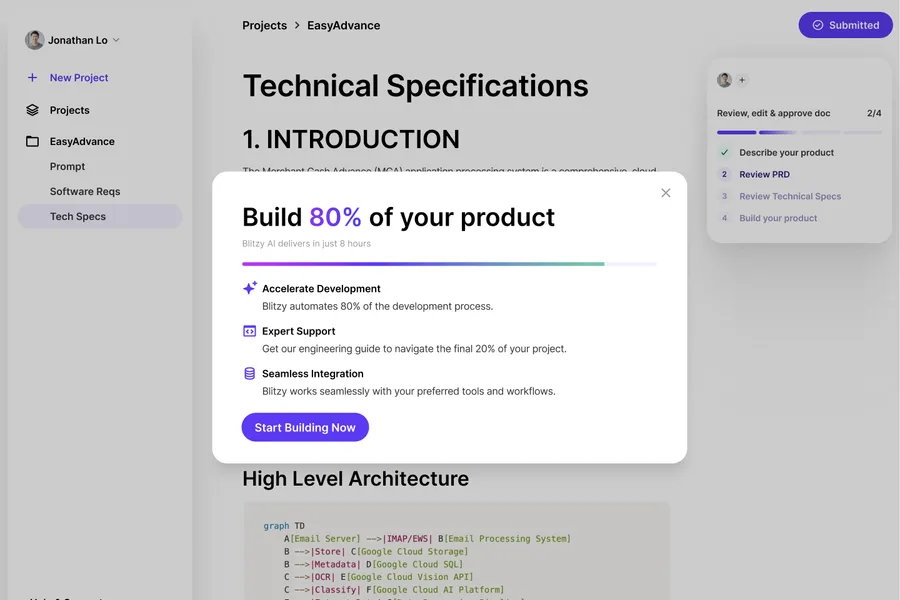
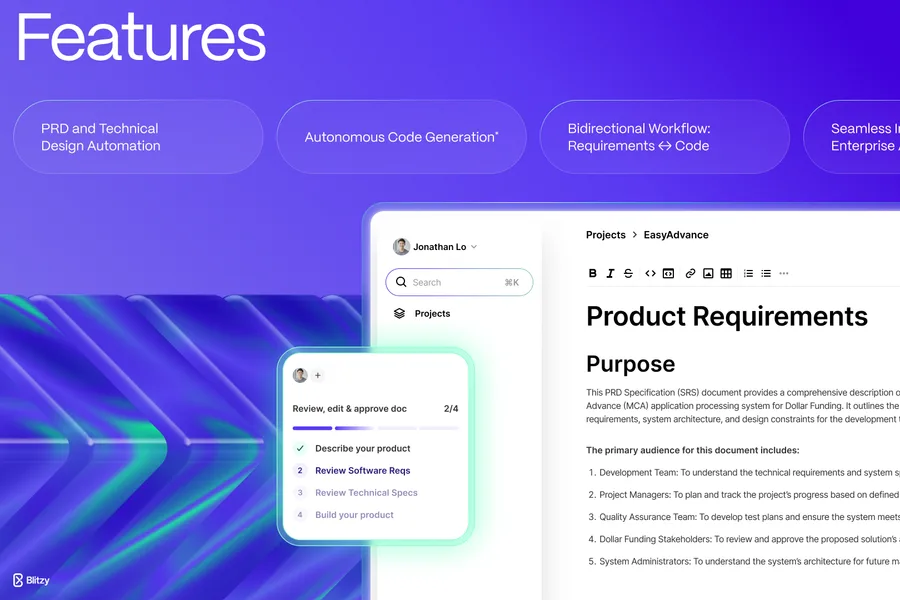
Blitzy’s software-requirements editor. A document titled “Software Requirements” is open for a project called EasyAdvance, with sections “Purpose”, “Scope” and “Goals:”. Purpose: “This Software Requirements Specification (SRS) document provides a comprehensive description of the cloud-based Merchant Cash Advance (MCA) application processing system for Dollar Funding. It outlines the functional and non-functional requirements, system architecture, and design constraints for the development team to implement the solution.” The primary audience: Development Team, Project Managers, Quality Assurance Team, Dollar Funding Stakeholders, and System Administrators. Scope: “The MCA application processing system is a cloud-based solution designed to automate and streamline Dollar Funding’s workflow for handling Merchant Cash Advance applications. The system aims to replace the majority of manual data entry processes, significantly improving efficiency and accuracy.” Alongside, a “Review, edit & approve doc” checklist standing at step 2 of 4: Describe your product (done), Review Software Reqs (current), Review Technical Specs, Build your product.
Three of Blitzy's own screens. The Projects list, with a "Create new project" button and a project card shared with three collaborators. The Charlie project's progress-ring screen, "Completing months of work in minutes...". And the same project's spec document, "Charlie: Technical Specifications," under review with a Save/Approve bar.
Blitzy’s build-complete screen for a project called FinSight. “Your code is ready” — 80% AI-built, 20% human tasks remain, over a progress bar four fifths filled. “Your app’s code is ready! Visit the GitHub repository to access and continue development.” Actions: Go to GitHub, Add a feature, Discover pending tasks. Alongside, a Members panel of five, and a Documents panel listing Your Prompt, PRD and Technical Specifications. Shown the way the client's own deck stages it: the desktop screen large and cropped at the frame's edge, with the mobile layout of the same screen overlapping it in front.
The system is the product's output, not ours
The design system was built first anyway, because Blitzy's platform reads it. Every app the engine generates inherits those tokens. So the component library was not a convenience for designers. It was part of what the product ships. Get it right once and everything the machine writes comes out coherent.
The deck used the same language. That let one document work on both audiences: a buyer reading for credibility, an engineer reading to see whether the thing is real.
All of it was built in Figma next to Blitzy's engineers, so what shipped matched what was drawn. The screens came out of the same room. Several prototypes went in front of the founders and their engineers, got argued over, and narrowed down until one was worth building.
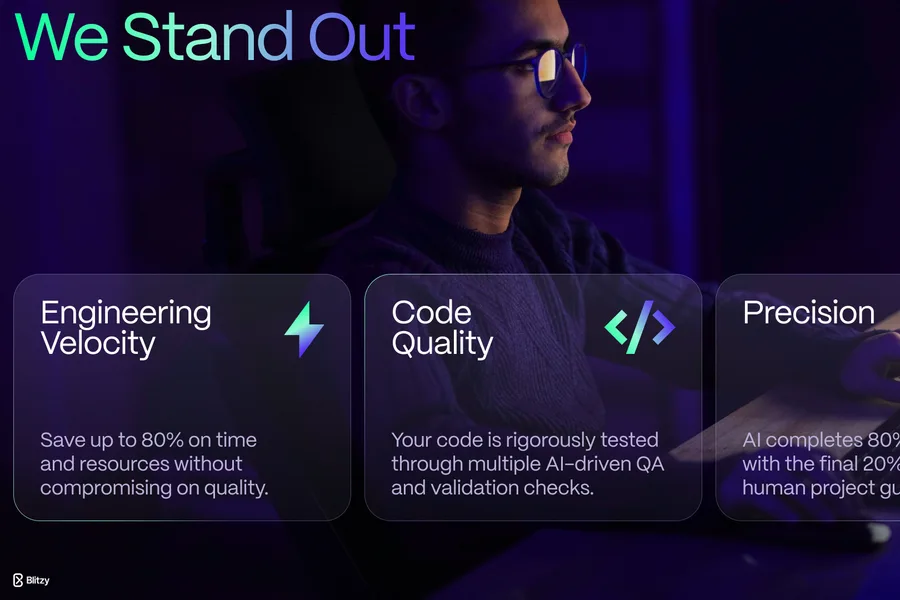
A slide from Blitzy’s deck: “Deep Technology — the leaders in System 2 AI”. “AI that thinks before it builds, combining deep reasoning and execution for reliable outcomes.” “3,000 specialized AI agents to build products and add features across any technology.” “Patent-pending code generation ensures accurate, validated, and dependable solutions.”
A slide from Blitzy’s deck: “Benefits”. “Reduce development time and costs dramatically.” “Compatible with any programming language.” “Utilize existing APIs, tech stack, and coding standards.” “Designed to create robust, enterprise-grade solutions.”
Blitzy’s logo: a line-art “B” monogram drawn as a single continuous line, with a chevron inside it, on the brand’s blue-to-green gradient.

We didn’t want a team that would just build what we asked for, and Gev’s didn’t. They pushed us to get it right, argued when it mattered, and moved like founders in their own company.
 Brian Elliott, Co-Founder & CEO, Blitzy
$1.4 billion later
The V1 became the product Blitzy took to market: the screens, the deck, and a component library its own engine builds against.
In May 2026 the company raised $200 million led by Northzone, at a valuation of $1.4 billion.